


This year’s Earth Overshoot Day falls on August 1st: Humanity will have used nature’s resource budget for the entire year, according to our calculations, building on the National Footprint and Biocapacity Accounts, now maintained by York University under the governance of FoDaFo.
By comparing the Ecological Footprint with the planet’s biocapacity, it tells us when each year’s Earth Overshoot Day occurs. Falling on August 1st means that humanity is currently using nature 1.7 times faster than our planet’s ecosystems can regenerate. It is like using 1.7 Earths. Overshoot is possible because we can overuse and deplete our natural capital. This compromises humanity’s resource security. The costs of this global ecological overspending are becoming increasingly evident in the form of deforestation, soil erosion, biodiversity loss, and the buildup of carbon dioxide in the atmosphere. The latter leads to climate change, more frequent extreme weather events and lower food production.
Earth Overshoot Day held steady for nearly a decade. It already occurs just after 7 months of the year have passed. The remainder of the year represents the overuse which adds depletion and loss to the biosphere. Even as the date holds steady, the pressure on the planet keeps increasing. This is making the situation ever riskier, since damage from overshoot accumulates over time.
Overshoot will end. The question is how: by design or by disaster. The preferable option is through deliberate efforts.
It takes focus, innovation, and effort to succeed, as athletes have demonstrated in every Olympics. For instance, Jesse Owens, the fastest runner of the 1936 Olympics, powerfully highlighted the menace of racism. Back then, humanity may have used about 0.6 Earths. Dick Fosbury revolutionized the high jump at the 1968 Olympics, when humanity used little under one Earth. By 1988, when Olympian sailor Lawrence Lemieux stopped from his lead position to rescue two capsized competitors, humanity already used 1.3 Earths. In 1992, when the US basketball team won gold, humanity’s demand went down again to 1.2 Earths. In 2008, as Usain Bolt started to break Olympic records, human use had grown to 1.6 Earths. Will we have the resolve to move out of overshoot at record speed?
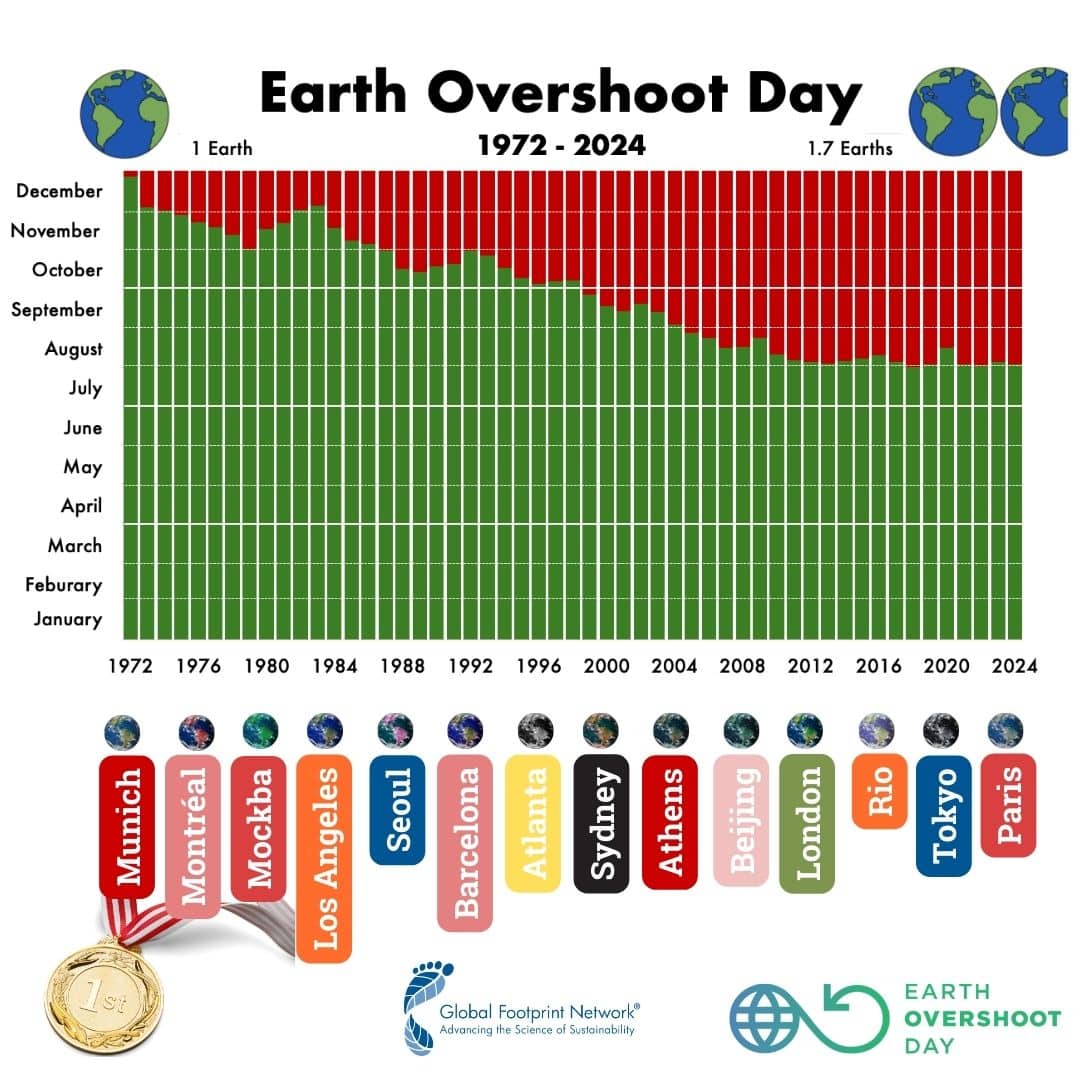
Solutions that #MoveTheDate are available and financially advantageous. Significant opportunities are to be found in five key areas: Cities, Energy, Food, Population, and Planet. The Power of Possibility highlights options that move Earth Overshoot Day. For instance, cutting CO2 emissions from fossil fuel burning by 50% would #MoveTheDate by three months. There are also businesses that #MoveTheDate as they expand. Such businesses may be the ones best positioned to gain value in a future of climate change and resource constraints.
For Media Contact: media@footprintnetwork.org