


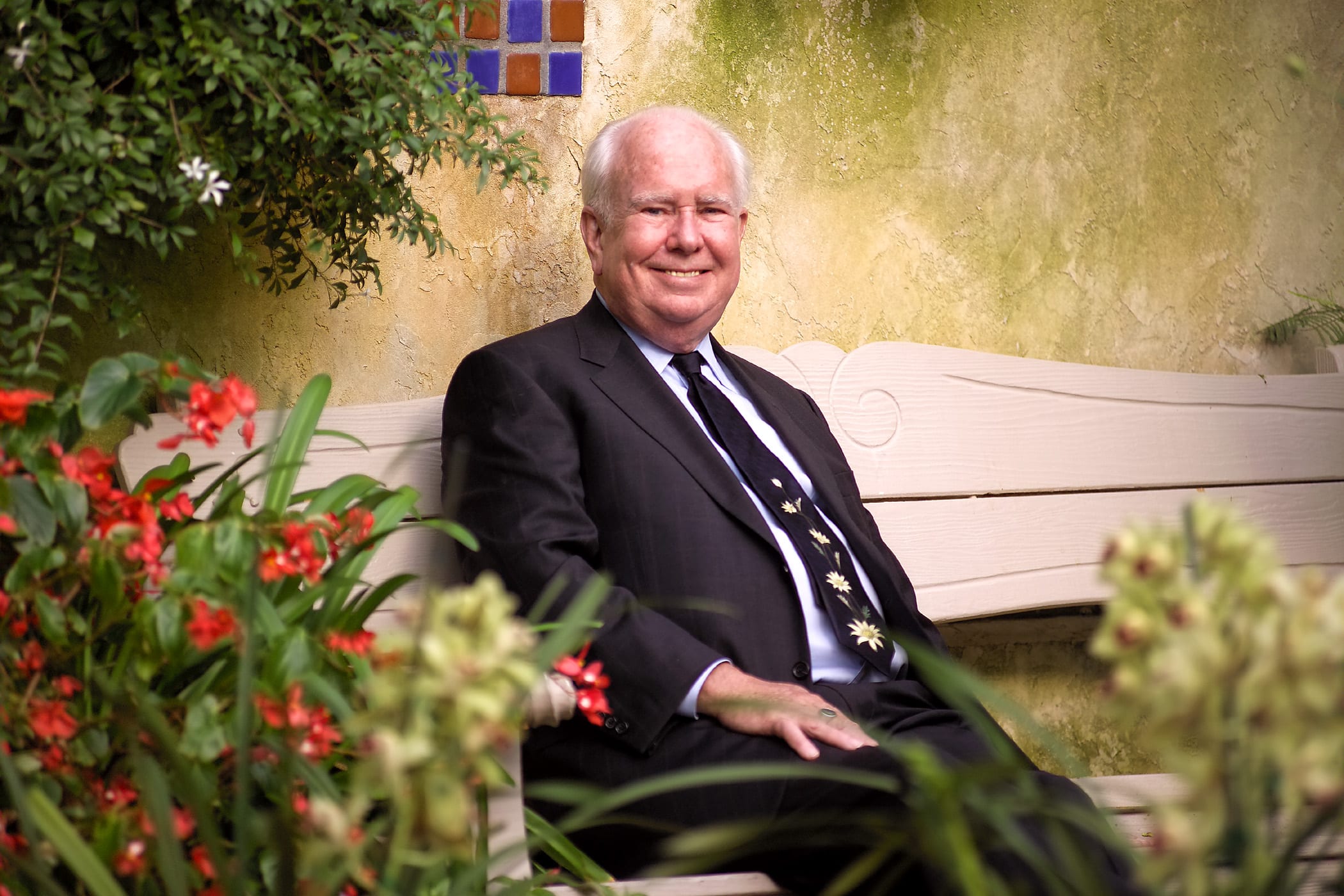
Ravens are edge species: versatile, intelligent. They are comfortable in distinct habitats, highly adaptable and rapid learners. They have the largest brain relative to body size of any bird. In many ways, they’re not unlike Peter, who himself is a truly unique life form.
Peter Raven’s genes have proven remarkably resilient. They’ve weathered five mass extinctions, or six, if we count the one currently unfolding. And then there is one more: on his maternal side, his genes survived the legendary 1847 Donner Party trek through the Sierra Nevada, where nearly half the group vanished in the brutal winter. Survival, it seems, runs deep in his lineage.
Peter brought that same vitality to life itself, embracing it in all its dimensions. One of the dimensions was his powerful passion for the astonishing diversity of plants. His story begins in motion: his mother traveled by clipper flying boat through the still-unbridged San Francisco Golden Gate all the way to Shanghai, where Peter was born. Though his time in China was brief, it sparked a lifelong connection, and he remained a devoted ally of Asian botany and biodiversity conservation ever after.
Back in the San Francisco Bay Area, now proudly spanning the Golden Gate Bridge, Peter discovered a fascination with small creatures and the plants that sustain them. Before long, he had become California’s youngest botanical prodigy.
Yet Peter was far more than a botanist, evolutionary biologist, or the extraordinarily successful director of the Missouri Botanical Garden. Nor was he defined solely by his many honors such as his membership in the Pontifical Academy of Sciences (where he advised Pope Francis on Laudato Si’), or his presidency of the AAAS. Above all, Peter was a gifted connector of people, a natural educator, and a joyful blend of humor and brilliance.
Parallel to fellow Global Footprint Network advisors, including Tom Lovejoy and E.O. Wilson, he was one of the pioneering voices calling for the protection of biodiversity. Tireless and generous, he constantly sought new ways to make the case, to open doors for emerging researchers, and to bring the message to audiences everywhere, always with warmth, clarity, and purpose.
Importantly, Peter was also among the few who spoke plainly about the scale of humanity’s impact: our vast and growing demand on the biosphere as the central driver behind the 5 fundamental forces of biodiversity loss.
I had the great privilege of collaborating with Peter on numerous research papers (see the list below). I always admired his clarity of thought and his effortless, elegant writing.
One of the last pieces we worked on together, revised again and again over the years, and repeatedly rejected by various journals, was an invitation to our colleagues to rethink the forces driving planetary degradation. Here’s one of the drafts. Our aim was simple: to show that responding to ecological overshoot is not merely a noble nicety but a nonnegotiable necessity. Too often, efforts begin from the assumption that preserving the web of life is important for humanity, yet economically unattractive for individuals, companies, or countries. We argued the opposite. After all, if you know you’re about to be thrown into the ocean, postponing swimming lessons until everyone else takes them isn’t strategy. It’s folly.
Below you’ll find some of the papers we wrote together, along with other glimpses into Peter’s remarkable life. He gave himself fully, right to the end, and his legacy continues to bloom.
Thank you, Peter, for your lighthearted, infectious, can-do spirit, and for your friendship and deep humanity.
More on Peter:
- The Missouri Botanical Garden remembering Peter
- The New York Times portraying Peter back in the late 1990s and again in his obituary
- Nature’s obituary of Peter
- Peter in the Wikipedia
Work we did with Peter:
Raven, Peter, Zhiyun Ouyang, Paul Smith and Mathis Wackernagel, 2023. “The Shenzhen Congress and Plant Conservation: What Have We Accomplished in the Six Years Since?” J. Syst. Evol. 2 November 2023, http://doi.org/10.1111/jse.13030
Bradshaw CJA, Ehrlich PR, Beattie A, Ceballos G, Crist E, Diamond J, Dirzo R, Ehrlich AH, Harte J, Harte ME, Pyke G, Raven PH, Ripple WJ, Saltré F, Turnbull C, Wackernagel M and Blumstein DT, 2021. Underestimating the Challenges of Avoiding a Ghastly Future. Front. Conserv. Sci. 1:615419.
Wackernagel, M., Hanscom, L., Jayasinghe, P., Lin, D., Murthy, A., Neill, E., Raven, P., 2021. The importance of resource security for poverty eradication. Nature Sustainability. Volume 4, pages731–738. https://doi.org/10.1038/s41893-021-00708-4. Plus supplementary information. Summaries are available in the Global Footprint Network blog and this press release.
Raven, P., Wackernagel, M., 2020. Maintaining biodiversity will define our long-term success. Plant Diversity, Volume 42, Issue 4, August 2020, Pages 211-220. https://doi.org/10.1016/j.pld.2020.06.002
Wackernagel, M., Lin, D., Evans, M., Hanscom, L., Raven, P., 2019. Defying the Footprint Oracle: Implications of Country Resource Trends. Sustainability, Volume 11 Issue 7, 2164, https://doi.org/10.3390/su11072164
Wackernagel, M., Terra Incognita: In Search of the Disconnect, in Partha Dasgupta, Peter Raven, Anna McIvor (ed) (2019) Biological Extinction: New Perspectives. Cambridge University Press, UK. Based on Workshop on Biological Extinction, February 28 – March 1, 2017, Jointly Sponsored by The Pontifical Academy of Sciences and The Pontifical Academy of Social Sciences https://www.cambridge.org/core/books/biological-extinction/ED9DDEEEF070722801383DBED553F395
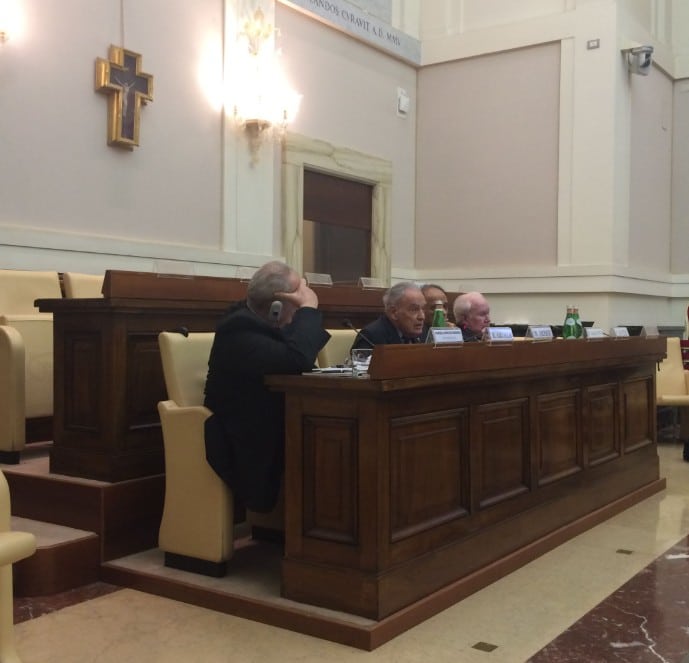
Peter at the Pontifical Academy of Science with Werner Arber, Partha Dasgupta, and Mgrs. Marcelo Sanchez Sorondo, in 2017.
Top picture – Peter Raven, copyright Missouri Botanical Garden