


Biodiversity
Healthy ecosystems are essential for the survival of humans and all other species. However, with growing human populations and consumption, these ecosystems face increasing pressure, undermining their health. Ecological Footprint accounting is a management tool for guiding decisions toward better outcomes, ones that allow all to thrive on our life supporting planet.

The threats facing the rich array of plant and animal life on the planet seem greater than at any time in modern history. Problems such as climate change, water shortages, overharvesting, invasive species, pollution, and habitat disruption —visible signs of human pressure on the planet’s finite resources— are also driving down wildlife populations worldwide. Vertebrate populations are down, on average, 73 % since 1970, according to the Living Planet Index.
All five distinct mechanisms that drive down biodiversity are ultimately symptoms of ecological overshoot, the reality that the human economy is demanding more from nature than nature can regenerate. Biocapacity offers a powerful lens for approximating overall pressure on biodiversity, even though its accounting focuses on the quantity of nature’s use. Qualitative dimension could also be added as an additional layer of such analyses, for example, assessing how intensively each global hectare is utilized. But unless we bring the scale of human demand into alignment with what our planet can regenerate, unless we reduce the quantity of human demand, qualitative improvements cannot be effectively scaled. Gains made in one place would simply shift demand to another location.
Stemming biodiversity loss with the Ecological Footprint
The most systemic way to address biodiversity loss, and to lay the foundation for a nature‑positive future, is to advance strategies that reduce global ecological overshoot. Because all five drivers of biodiversity loss are correlated with increasing human demand, it is evident that lowering overshoot will improve the biosphere’s viability. While we may not be able to pinpoint exactly where improvements occur, we can be confident that overall pressure on ecosystems will decline. By adding supply chain analytics to the Footprint accounts, at least for the non-carbon portions, it becomes possible to indicate where the biodiversity pressures are being reduced.
A further advantage is that activities, investments, and assets that contribute to reducing global overshoot are also likely to maintain or increase their long‑term economic value. The logic is simple: assets that remain useful in a resource‑constrained world are more likely to remain valuable. A framework outlining how this can be measured for companies is provided here.
There are numerous examples of solutions that, when scaled up, reduce overshoot. At Global Footprint Network, we refer to these as the “Power of Possibility”. We have begun using these examples to illustrate how much Earth Overshoot Day could be delayed if such approaches were adopted more widely. We argue that these options are not only ecologically beneficial but also economically advantageous, as they are more likely to retain their relevance, and therefore their value, over time.
Official biodiversity applications of Ecological Footprint accounting
In 2002, under the auspices of the Convention on Biological Diversity (CBD) the leaders of the world’s governments committed to significantly halting the rate of biodiversity loss by 2010. They adopted a suite of indicators, brought together as the Biodiversity Indicators Partnership (BIP), to provide information on biodiversity trends and assess progress toward their target. Global Footprint Network is a Biodiversity Indicators Partnership Key Indicator Partner, and the Ecological Footprint has been officially adopted by the CBD to be included among its biodiversity indicators.
In CBD’s 2022 Kunming-Montreal Global Biodiversity Framework, the Ecological Footprint is mentioned in Target 16, and in four places of its proposed monitoring approach. Results from Ecological Footprint accounts are a core indicator of the Intergovernmental Science-Policy Platform on Biodiversity and Ecosystem Services (IPBES). The Dasgupta Review (2021) also heavily relied on the Ecological Footprint metric.
What the Footprint can tell us about biodiversity
Our Ecological Footprint accounts show that humanity currently demands 78% more from our planet than its ecosystems can regenerate. But to secure 85% of the world’s biodiversity, requires humanity not to use more than half of the Earth, according to the late Harvard biologist E.O. Wilson. In other words, human demand now exceeds 3-fold a rate that is compatible with lasting conservation, including stabilizing our climate.
The gap between human demand and what our planet can regenerate (biocapacity) is known as ecological overshoot. It results in the depletion of the natural capital that all species (including our own) depend on for their livelihood. It also results in the accumulation of greenhouse gases in the atmosphere that leads to climate change, with profound implications for ecosystems and the species they support as well as for our societies well being and economic stability.
Compared to what our planet can regenerate, humanity’s Ecological Footprint has grown 140 percent since 1961. The growing ecological deficit, leading to a burgeoning ecological debt, puts ever more pressure on the resources wild species need to thrive. Therefore, it should not come as a surprise that the average population size of vertebrate species has declined by 73 percent from 1970 to today.
Looking at the various consumption sectors that go into the Ecological Footprint can provide us with a glimpse of the human activities that are drivers of biodiversity loss. (Click here for a chart illustrating how various consumption sectors contribute to habitat loss, overexploitation, pollution, climate change and other key biodiversity threats.)
Meeting the Biodiversity Challenge
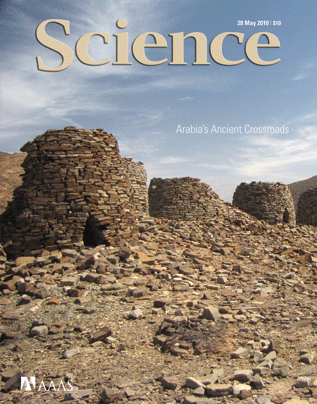 A 2010 report in the journal Science, to which Global Footprint Network was a contributor, provided a stark assessment that the world’s governments had not met the target set by the Convention on Biological Diversity, and had instead presided over enormous declines.
In October 2010, the parties to the CBD met in Nagoya, Japan to decide whether to adopt a new biodiversity target and new indicators for the post-2010 era. At the conference, the Biodiversity Indicators Partnership presented a list of strategic goals, including means, milestones and indicators, for achieving the goals set forth in the CBD. Click here to download the full list of BIP recommendations. In December 2022, the monitoring framework for the Kunming-Montreal agreement included the Ecological Footprint.
Ultimately halting species loss and enabling biodiversity to thrive will require bringing human demand for ecological services into balance with what nature can renewably supply.
By advocating for decision-making that takes the biosphere’s limited resource budget into account, Global Footprint Network is promoting a world where all, including other species, can thrive within the means of our planet. The Network makes accessible to decision-makers, of households, companies, cities and countries, the risks that resource limitation and declining biodiversity pose to them as well as to our societies’ well-being and economic stability.
Additional Resources
• Underestimating the Challenges of Avoiding a Ghastly Future, published in Frontiers in Conservation Science. January 2021.
• The Shenzhen Congress and Plant Conservation: What Have We Accomplished in the Six Years Since?” published in J. Syst. Evol. 2023.
• Maintaining biodiversity will define our long-term success, published in Plant Diversity. Volume 42, Issue 4, August 2020.
• Global Biodiversity Outlook 5, Secretariat of the Convention on Biological Diversity (2020), Montreal (for Footprint, see pages 48 & 49).
• “Stomping on Biodiversity: Humanity’s Ecological Footprint,” published in the Commonwealth Ministers Reference Book.
• Science: “Global Biodiversity: Indicators of Recent Declines,” Vol 328, Issue 5982, 28 May 2010.
• “Ecological Footprint: Implications for biodiversity”, published in Biological Conservation, Volume 173, May 2014, Pages 121-132
• 2010 and Beyond: Rising to the Biodiversity Challenge, published by Global Footprint Network and WWF, 2010.
• The Economics of Biodiversity: The Dasgupta Review , published by the UK’s Treasury in 2021. Global Footprint Network summarized it here.
• BIP’s post-2010 strategic goals for halting biodiversity declines, Conference of the Parties to the Convention on Biological Diversity, 2010.
• Exploring the societal factors enabling to halt and reverse the loss and change of biodiversity. (ETC BE Report 2024/2). by A. Galli, N. Sommerwerk, M.S. Mancini, and S. Pihlainen. For the EEA’s European Topic Centre on Biodiversity and Ecosystems. Summarized here and downloadable from here.
• Monitoring framework for the Kunming-Montreal global biodiversity framework, COP15 2022. Also compare with Global Footprint Network’s blog on this framework here.
• Media Release of IPBES. “Human well-being at risk. Landmark reports highlight options to protect and restore nature and its vital contributions to people,”26 March 2018.
IPBES adopts Ecological Footprint as a Core Indicator
The Intergovernmental Science-Policy Platform on Biodiversity and Ecosystem Services (IPBES), an independent intergovernmental body established in 2012, has added Ecological Footprint and biocapacity metrics to its list of Core Indicators. Using Footprint data, IPBES recognizes as a scientifically “well established” trend that countries with an ecological deficit put tremendous pressure on resource security and biodiversity outside of their borders.
Living Planet Report
Every two years, WWF and the Zoological Society of London publish the Living Planet Report, the world’s leading science-based analysis on the health of our planet and wildlife populations and the impact of human activity. Global Footprint Network has collaborated with WWF on the biennial Living Planet Report since 2000.